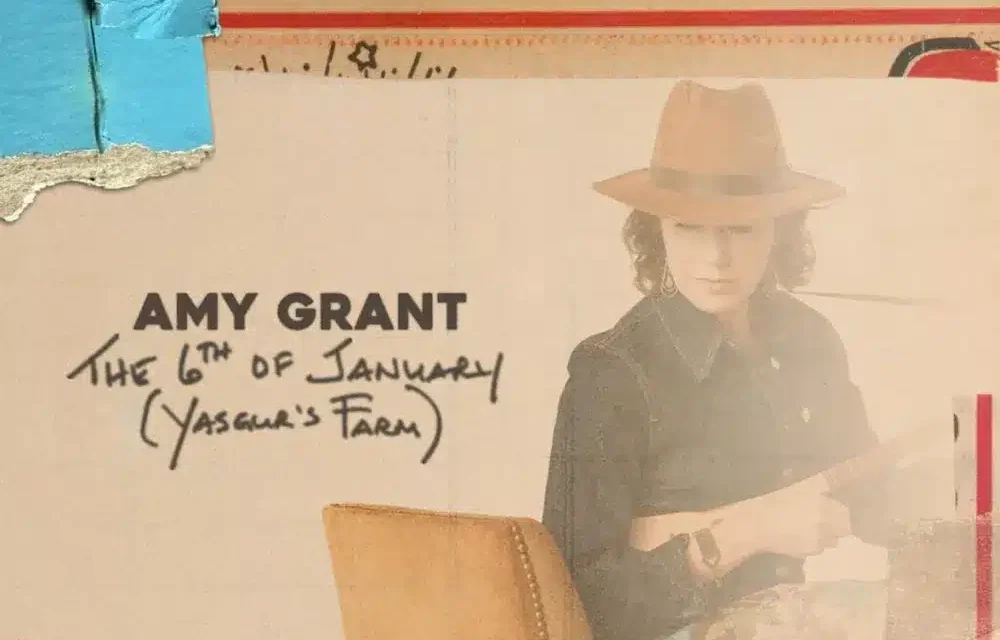
The music evokes classics by Suzanne Vega, Shawn Colvin, and Lucinda Williams. Maybe it is the pristine but heat manufacturing by Mac McAnally, full of strummed guitars. Or possibly it is Amy Grant’s easy supply, the place her melodic variations function catchy hooks. A very poignant verse references John Lennon. In her track “The sixth of January (Yasgur’s Farm),” launched on January 6, 2026, Amy Grant not solely moved me however spurred me to share it with anybody open to its message.
That need to share displays Grant’s personal fervor in conveying the track’s that means. The discharge date marks 5 years because the rebellion on the U.S. Capitol, the guts of American democracy. In “The sixth of January,” Grant makes use of that occasion to check how far the USA has drifted from the beliefs of the Nineteen Sixties, singing, “I look forward and understand we’ve misplaced our method.”
Amy Grant will be the star of the recording and the official video, however it’s vital to acknowledge “The sixth of January” as a collaborative effort. The track was penned by Sandy Emory Lawrence, a considerably reclusive songwriter. In 2013, she was honored with the ASCAP Sammy Cahn Award for her track “The Fairly One” and has labored with the nation duo Joey + Rory. She has additionally launched one CD, The Hammer Lands, beneath her personal title.
Earlier than venturing into songwriting, Lawrence aspired to be a tutorial poet. This element, together with insights from her 2016 interview with Southern Publicity Journal, reveals that the lyrics of “The sixth of January” are genuinely poetic—dramatic but easy, lush with nuances. It opens with a mysterious line: “She says possibly it’s the time of 12 months / Or possibly it’s the time of man.”
This abrupt introduction hints at a narrative in progress. Initially, you may assume this “she” is somebody personally related to Grant, earlier than realizing that it references Joni Mitchell’s 1969 track “Woodstock,” as Lawrence has drawn inspiration from Mitchell. At simply 15, Lawrence noticed Mitchell carry out on tv and felt a profound connection: “that’s me. That’s who I’m.”
Mitchell’s track in regards to the 1969 Woodstock pageant was crafted shortly after the occasion, and it was subsequently lined by numerous artists, together with Crosby, Stills, Nash, and Younger. “Possibly it’s the time of 12 months / Possibly it’s the time of man” might not ring a bell, however one may recall strains from “Woodstock”: “I’m happening all the way down to Yasgur’s farm / I’m going to affix in a rock ‘n’ roll band… By the point we bought to Woodstock, / We have been half one million robust.”
Each “Woodstock” and “The sixth of January” discover journeys. Within the latter, the singer reminisces whereas listening to a “Nineteen Sixties playlist” and sipping “a beer.” Abruptly, she finds herself “16 once more,” reflecting on that transformative decade. Though Amy Grant was born in 1960 and commenced her profession in Christian pop music at 16, she clearly identifies with the idealism of the Nineteen Sixties. Born in 1965, I additionally resonate with that ethos. The eager for unity echoes Lennon’s anthem: “I hope sometime you’ll be part of us / And the world will reside as one.”
The official video captures this second fantastically, exhibiting a teenage image of Grant fading into her grownup self. Each variations ponder about “the long run” with a way of trepidation: “What’s it hiding up its sleeve?” The grownup, recalling her youthful optimism, shakes her head, lamenting, “All that wide-eyed hope / Have been we so naive.” A fast reduce reveals her trying to find the positioning of the music pageant within the Hudson Valley, evoking the strains from Mitchell’s track about returning to the backyard, although they continue to be unmentioned but becoming.
Woodstock was not truly within the city of Woodstock however in close by Bethel, the place Max Yasgur, a conservative farmer, opened his land. The singer’s plea—“Hey mister, the place’s the street to Yasgur’s farm?”—carries each literal and metaphorical connotations. The “mister” may very well be an space resident, Yasgur’s ghost, or a timeless voice akin to Coleridge’s Historic Mariner. “He stares at me with pity and alarm / Says that crowd left right here way back / Scattered all to hell and Harper’s Ferry / On the sixth of January.”
Lawrence and Grant count on listeners to acknowledge the historic significance of Harpers Ferry, Virginia, which witnessed John Brown’s intentions in 1859. It is the listeners’ accountability to attach this historical past with the occasions of January 6, 2021—the Capitol rebellion. The implication is stark: it was a violent try and undermine democracy fueled by falsehoods surrounding a stolen election.
Some might interpret the insurrectionists’ actions as patriotism, however the actuality is that their actions triggered in depth injury and trauma, ensuing within the heartbreak of quite a few households. Grant and Lawrence mourn these wounds, articulating how democratic beliefs might have perished that day or even perhaps later, when insulting pardons have been issued to the insurrectionists.
What, then, is the importance of Harpers Ferry? Why are the individuals “scattered all to hell”? The lyrics invite listeners to have interaction with this narrative, as every phrase performs an important position—no single phrase reveals the complete image. Because the track progresses, the singer finds herself in a grocery retailer the place an instrumental model of Lennon’s “Think about” drifts by means of the air. The video respectfully includes a 1971 clip of Lennon.
With these utopian lyrics swirling in her thoughts, she wrestles with the absurdity of societal circumstances, pondering how Lennon would react. Many years after his loss of life, “[h]e’s both bent over laughing / Or spinning in his Strawberry Fields.” This reference to “Strawberry Fields Perpetually,” an exploration of consciousness, is visually represented by pictures of the mosaic tribute to Lennon in Central Park.
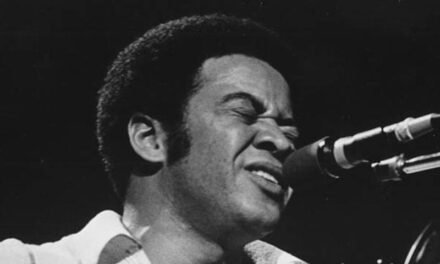
What does Lawrence’s poignant songwriting convey? Is Lennon commenting on his timeless beliefs being repackaged into one thing shallow and consumerist? In “How Do You Sleep?”, he famously critiqued his former collaborator, Paul McCartney, with strains like “The sound you make is Muzak to my ears.” For Lawrence, who cites each Lennon and McCartney as main influences, recognizing the transformation of “Think about” into Muzak provides one other layer of sorrow.
There’s a broader interpretation of Lennon’s hypothetical responses. With the refrain asserting the dispersal of the Woodstock crowd and, by extension, the desires of the Nineteen Sixties, you possibly can envision Lennon reflecting on modern America. After emigrating to New York Metropolis in 1971 and preventing in opposition to deportation within the mid-Nineteen Seventies, many marvel how he would understand the present state of the nation amidst rising authoritarianism and local weather change.
When Grant revisits the refrain—“He stares at me with pity and alarm”—Lennon’s presence might linger. Why would he be answering from past about Yasgur’s farm? Progressively, he transforms from a logo of idealism to the singer’s authentic inquiry: a timeless voice.
Lawrence artfully introduces one other self-referential second. The singer hears Marvin Gaye’s “What’s Going On” on the automobile radio, linking it again to her Nineteen Sixties playlist whereas additionally situating “The sixth of January” inside topical music. “Picket strains and picket indicators,” Gaye laments; “Don’t punish me with brutality.” Sadly, some struggles stay unchanged.
“What’s Going On” now explicitly connects with problems with race, a theme hinted at with Harpers Ferry however delivered to the forefront right here. The juxtaposition of political instructions turns into vital: “Is it proper on pink or left on MLK?” This intelligent wordplay invitations listeners to replicate on civil rights and the place we stand as a society at present.
Notably absent in these lyrics is the towering affect of Nineteen Sixties protest music, Bob Dylan. Dubbed a poetic genius and Nobel laureate, his affect on topical songwriting resonates with me, particularly after I used to be listening to his Christian music previous to discovering “The sixth of January.” Whereas I’ll not share his religion, I admire the highly effective artistry of Christian music.
Amy Grant is well-known for her Christian music, however many might not understand her crossover enchantment into secular music. Curiously, YouTube’s suggestions for “The sixth of January” appeared to align completely with my latest musical explorations.
Some conservative Christian critics have taken challenge with “The sixth of January,” notably relating to its appropriation of “Think about.” On condition that Lennon and his co-writer, Yoko Ono, invite listeners to check a world devoid of heaven or hell, it is a contentious mixing of beliefs. Whether or not Christians ought to embrace parts of “The sixth of January” is a dialogue value having.
Lawrence and Grant seemingly welcome such dialogues. “The sixth of January” resonates with urgency and significance, akin to the sharp critique discovered within the Ramones’ 1985 track about Reagan’s go to to a Nazi cemetery, but it delivers its message with a slower, extra contemplative burn. This track articulates its essence whereas fostering open-ended interpretations, encouraging listeners to have interaction deeply with its themes.
On this method, their track turns into a communal expertise—a participatory act of engagement, very like a democratic course of.