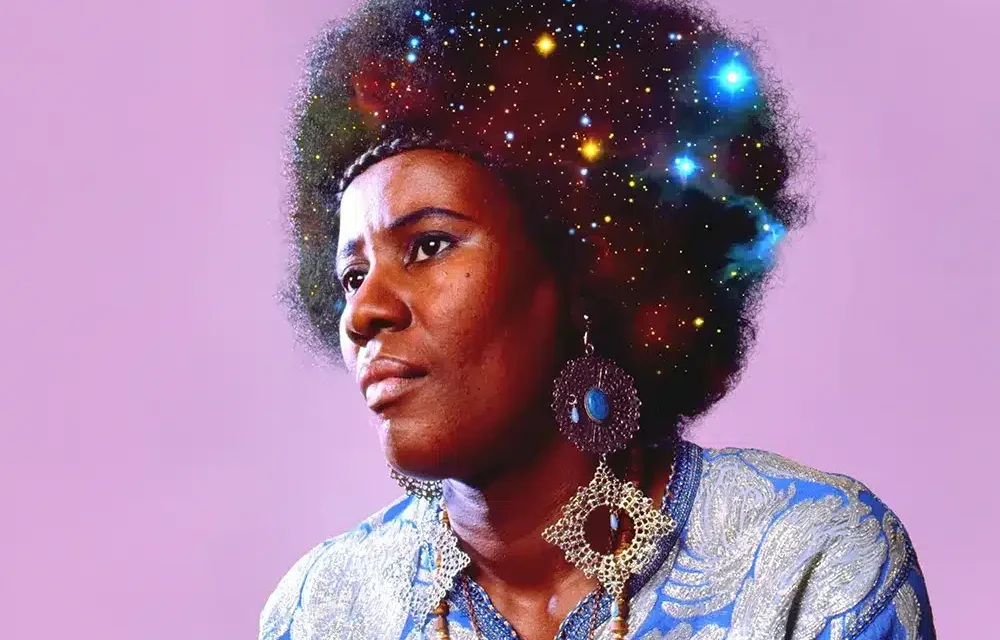
Alice Coltrane was far more than the customarily underrated pianist in her husband John Coltrane’s later group; she was a pioneering musical visionary in her personal proper. Proficient in varied types together with classical, bebop, and free jazz, she expanded her abilities to the harp and organ, showcasing her versatility.
Within the later levels of her profession, Alice emerged as a unprecedented arranger, creating ethereal and grand sounds that grew to become hallmarks of her solo works. Her 1971 album, Journey to Satchidananda, not solely anticipated the New Age and Ambient music actions however continues to depart an indelible mark on up to date artists like Björk and Radiohead.
Alice Coltrane additionally embodied feminism and resilience, elevating 4 younger sons independently following her husband’s premature dying. She was a savvy businesswoman, managing John’s in depth catalog and musical legacy. But, maybe her deepest id was as a spiritualist. A relentless seeker of fact, Alice’s deep engagement with Japanese spirituality remodeled her into Swamini Turiyasangitananda (affectionately referred to as Turiya), an inspiring determine who led many to enlightenment on the ashram she based in California.
Veteran music journalist Andy Beta seeks to focus on the multifaceted nature of Alice Coltrane in his biography, Cosmic Music: The Life, Artwork, and Transcendence of Alice Coltrane. That is the primary complete biography of this visionary and sometimes misunderstood artist. Beta’s work has twin goals: to unveil lesser-known elements of her formative years and various musical endeavors after John, and to delve into her vital religious odyssey.
Alice McLeod was born in 1937 in Detroit, a metropolis wealthy in musical heritage. Following her mom’s footsteps, she grew to become a keyboardist and choir chief at her native Baptist church, cultivating a lifelong ardour for Gospel music that deeply infused her work.
As she grew up, Alice was influenced by notable figures like Motown’s Berry Gordy and Aretha Franklin, and later carved her personal path alongside jazz greats from Detroit like Barry Harris, Yusef Lateef, and Kenny Burrell. Her connections with celebrated musicians, together with her bassist half-brother Ernie Farrow and future collaborator Joe Henderson, formed her youth.
Terry Pollard, a trailblazing feminine bebop pianist, performed a vital function in Alice’s early profession, giving her first house piano and facilitating her entry into the skilled music scene by taking her place in vibraphonist Terry Gibbs’ band.
Beta elaborates on Alice’s youth, highlighting the colourful music scene within the now-vanished Black Backside neighborhood and the standard, nurturing environments of Detroit’s black center class the place she and her friends honed their craft. He additionally addresses the emotional scars left by city renewal insurance policies that razed communities and incited riots.
Alice’s formative years was marked by profound experiences; she encountered out-of-body experiences and astral projection by the age of 9, which continued all through her life, influencing each her music and main life decisions till her passing in 2007.
Her relationship with John Coltrane, whereas pivotal, is just a part of her broader story. After a quick marriage in Paris to vocalist Kenneth Hagood, she met John, whose album Africa Brass had captivated her at Birdland in New York in 1963. Their marriage in 1965 transitioned her from being a homemaker to moving into the function of a musician, stepping in for McCoy Tyner in late 1966.
Alice’s distinctive piano work enriched a lot of John’s later free recordings, together with the profound 1973 album, Dwell in Japan. Beta means that John’s acclaimed piece “A Love Supreme,” penned in September 1964, embodies not only a religious hymn but in addition a tribute to his love for Alice.
The affect of John’s dying in July 1967 was immense, plunging Alice into durations of despair and prompting hallucinations whereas she grappled with the truth of elevating 4 kids, the youngest solely 4 months outdated, alongside managing John’s in depth musical legacy. “Although that they had identified one another solely 4 years, Alice believed they have been two spirits united over eons,” Beta notes.
John bequeathed two vital legacies to Alice posthumously: a Lyon & Healy harp that arrived days after his passing, which she described as a manifestation of his spirit, and the imprint of his cosmic quest in her music. That harp grew to become very important to her inventive route.
In her house studio in Dix Hills, Lengthy Island, Alice devoted herself to her music late at evening after her kids had gone to mattress. This dedication led to the creation of a number of early albums, together with her debut, A Monastic Trio (1968), and the landmark Journey to Satchidananda (1971). For Alice, the excellence between piano and harp was profound: “the piano is the dawn, the harp is the sundown.”
Her musical and religious path was closely influenced by tapasya—Sanskrit for a rigorous religious self-discipline aimed toward purifying the thoughts and physique. Alice engaged in fasting, in depth meditation, and mystical experiences, together with encounters with John’s spirit, guiding her musical journey and the discharge of his posthumous works.
Months after John’s passing, a imaginative and prescient from Igor Stravinsky impressed Alice to report the “Firebird Suite.” She grew to become a faithful disciple of Swami Satchidananda, resulting in frequent pilgrimages to India that additional influenced her musical type and religious outlook.
The concluding chapters of Alice’s life weave her musical evolution together with her religious dedication. Albums like World Galaxy (1972) and Transcendence (1977) showcased orchestration that included Japanese parts, additional enriched with Gospel influences. Critics acknowledged and praised the depth of those works, which have been enhanced by her use of the Wurlitzer Organ, paying homage to John’s saxophone improvisations.
Her 1974 collaboration with Carlos Santana, Illuminations, emerged from an ethereal imaginative and prescient the place John appeared to Santana. The harp and percussion solo, “Vrindavana Sanchara” from Transcendence, is commonly cited as a precursor to New Age music.
Within the late Nineteen Seventies, Alice shifted her focus from music to religious pursuits, founding the Vedantic Heart in California and establishing the Sai Anantam Ashram on 82 acres within the Santa Monica Mountains in 1982.
Beta’s biography delves deeply into Alice’s explorations of Japanese philosophies, revealing her journeys in India the place she found bhajans—devotional songs that elevate the spirit. This quest culminated in her solo organ-and-vocal album, Turiya Sings (2021), and varied collections of her devotional music launched in cassette format which have since been compiled into World Spirituality Classics: The Ecstatic Music of Alice Coltrane (2017). Alice even took her ardour for spirituality and music to tv by way of her collection, Eternity’s Pillow, airing over 20 episodes within the mid-Nineteen Eighties, 4 of that are at the moment out there on the Criterion Channel.
Andy Beta has masterfully captured the essence and affect of Alice Coltrane, revealing her as each a groundbreaking musician and a major religious chief. Alice stands not solely as an inventive equal to her iconic husband but in addition as a guiding gentle whose messages proceed to resonate with new generations of seekers and music aficionados.