This interview has been barely refined for readability.
Flutist and composer Allison Loggins-Hull has constantly embraced storytelling in her work. Her tasks usually weave collectively parts of historical past and social commentary, evident in her collaborations with famend artists and establishments similar to Julia Bullock, The Metropolitan Museum of Artwork, Toshi Reagon, Alarm Will Sound, and Fort of our Skins. These thematic connections knowledgeable her acclaimed 2018 composition Homeland, which drew inspiration from difficult international occasions like Hurricane Maria, the Syrian refugee disaster, and the tragedy surrounding Michael Brown’s demise in Ferguson. Loggins-Hull displays, “The piece is my response to the tales of displacement that have been dominating the information on the time. I created a temper board with imagery, and water turned a recurring motif; I used timbral trills to echo the sound of troubled waters.”
Homeland rapidly gained recognition inside the flute neighborhood and served as a pivotal second for Loggins-Hull’s collaboration with The Cleveland Orchestra (TCO). In 2021, TCO hosted its first outside live performance throughout the COVID period on the historic Cozad-Bates Home, a website important to the Underground Railroad. Principal flutist Joshua Smith carried out Homeland earlier than an viewers that included Music Director Franz Welser-Möst. Loggins-Hull recollects, “Earlier than I knew it, I obtained a name from Cleveland asking for scores to assessment. Initially, I believed they have been simply contemplating me for a standalone efficiency, however weeks later, they invited me to change into their subsequent fellow!”
Usually, TCO provides a two-year residency for its Daniel R. Lewis Composer Fellows, however in Loggins-Hull’s case, they prolonged it to 3 years. She proposed a reimagined fellowship method that emphasised neighborhood engagement reasonably than confining her musical work to the orchestra alone.
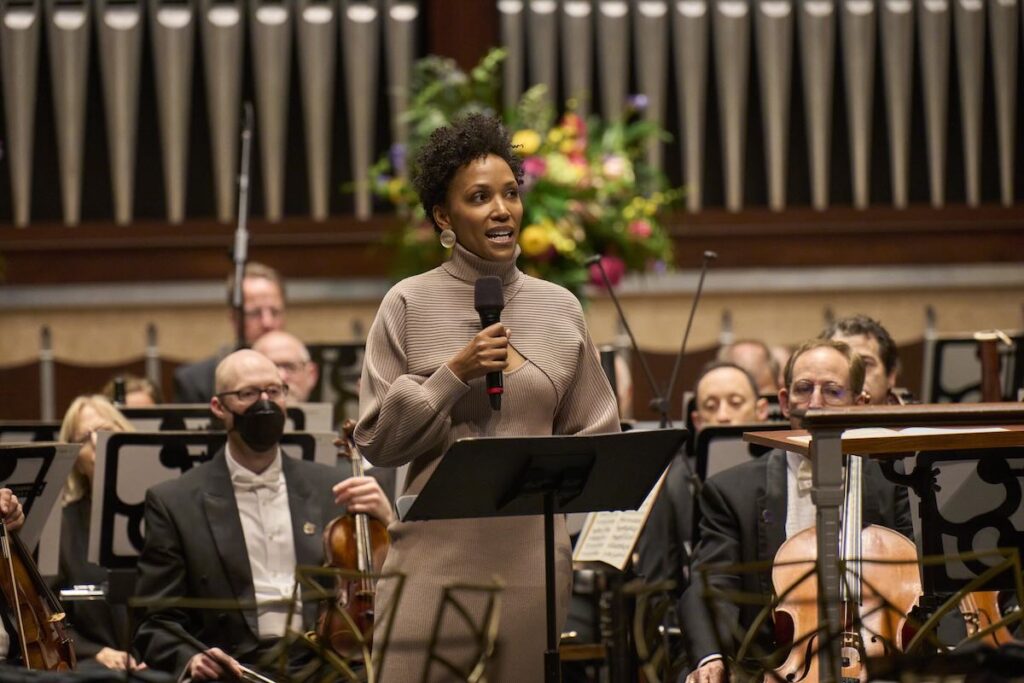
Intrigued by town of Cleveland, Loggins-Hull famous its modesty juxtaposed with its wealthy historical past and its standing as residence to one of many world’s main orchestras and prestigious medical establishments. “I used to be fascinated by how all these parts coalesced,” she shares. Her aim was to attach with native residents to grasp Cleveland’s historical past and create music that was uniquely reflective of town. Nonetheless, fostering belief between established establishments and native communities requires time, so TCO was supportive of an prolonged fellowship length. “I engaged with each division,” Loggins-Hull states, “and the passion was palpable. Musicians, board members, neighborhood schooling individuals—everybody was desperate to create music collectively. And the live performance corridor was packed!”
Central to her fellowship have been three live shows for the In-Group Chamber Music Sequence. On the Fatima Household Heart, a multigenerational hub that gives after-school applications and a senior choir, she curated the Religion program, which featured her personal religious and gospel orchestral preparations. Karamu Home, acknowledged as America’s oldest Black theater firm and related to Langston Hughes, showcased an interdisciplinary work by Valerie Coleman for each actors and musicians, amongst others. Moreover, the Ukrainian Bandura Youth Ensemble offered Blue and Gold, which mixed classical chamber music with Ukrainian people music preparations, that includes the culturally important bandura instrument.
Loggins-Hull’s experiences throughout her fellowship culminated in three works documented in Loggins-Hull: The Cleveland Residency (April 17, TCO Media), the orchestra’s first portrait album that includes a residing composer in practically a century. Her string sextet Legacy emerged as a direct results of her connections with neighborhood companions and was additional knowledgeable by the passing of her father throughout the fellowship. Every collaborating group showcased a powerful dedication to preserving cultural traditions throughout generations. This composition integrates gospel scales, blues influences, and cross-rhythms, seamlessly mixing the ethereal sounds of the bandura and conventional string writing.
These various musical roots got here collectively in Loggins-Hull’s orchestral piece Grit. Grace. Glory, which highlights her admiration for Cleveland’s dedication to excellence. She remarks, “The town’s tradition is rooted in a piece ethic that strives for excellent outcomes, which is completed with grace.” Cleveland’s industrial legacy fosters a “relentless sense of movement that’s nearly tangible.”
One other important work, Can You See?, initially composed for chamber ensemble, developed into an orchestral piece. It provocatively performs with acquainted melodic materials, urging contemplation on themes of corruption, fact, and justice. The Cleveland Orchestra premiered this orchestral model, which may even debut in New York Metropolis on the New York Philharmonic this month.
A second album, titled Patchwork (Could 1, Avie Data), options TCO musicians performing chamber works alongside Loggins-Hull on flute, providing a differing emotional perspective than her earlier fellowship work. “I regularly search to mirror on what’s true,” she shares. “That is what has transpired, and right here we’re; now what can we do?”
The piece The Sample, drawing on Ta-Nehisi Coates’ name for sincere narration, mirrors the continual battle from slavery via important historic actions just like the Civil Warfare, Jim Crow, and Civil Rights, expressing a musical portrayal of persistent setbacks. Kalief, for clarinet and piano, poignantly tells the story of Kalief Browder, a young person whose wrongful imprisonment led to his tragic demise. Right here, the clarinet conveys heartbreak and isolation, however Loggins-Hull insists on a hopeful conclusion: Shine closes the album with a celebration of resilience, that includes textual content from Zimbabwean-American poet U-Meleni Mhlaba-Adebo. The piece’s energetic stream and dynamic interaction between soprano Laquita Mitchell and Loggins-Hull on flute honor a lineage of perseverance.
Since concluding her fellowship with TCO in Could 2025, Loggins-Hull has remained lively in her musical journey. She will probably be in residence on the Spoleto Competition 2026, and her upcoming music cycle Friction continues her collaboration with Roomful of Tooth. Moreover, she usually performs with Jessie Montgomery’s The All the things Band. Nonetheless, Loggins-Hull attributes her ongoing successes primarily to the friendships cultivated over years within the discipline. She encourages rising composers to consider their contributions inside reciprocal creative communities that assist a vibrant ecosystem. “It’s in regards to the method by which you current your self and contribute to a bigger imaginative and prescient. We’re all striving for our particular person targets, and it turns into far more attainable when you’ve got your assist community. It’s way more rewarding… it’s basically a human expertise.”
I CARE IF YOU LISTEN is an editorially-independent program of the American Composers Discussion board, made potential by beneficiant donor and institutional assist. To assist the work of ICIYL, please take into account making a tax-deductible present to ACF. For additional details about ACF, go to composersforum.org.