Salvador Dalí famously described artwork as “the persistence of reminiscence,” suggesting that it embodies a lingering presence—an apparition of the previous woven into the current. In exploring works that grapple with their very own mortality, reminiscent of The Marble Index by Nico (1968), Nearer by Pleasure Division (1979), The Holy Bible by the Manic Avenue Preachers (1994), and Nirvana Unplugged (1994), few are as suffused with ghosts as The Wall by Pink Floyd.
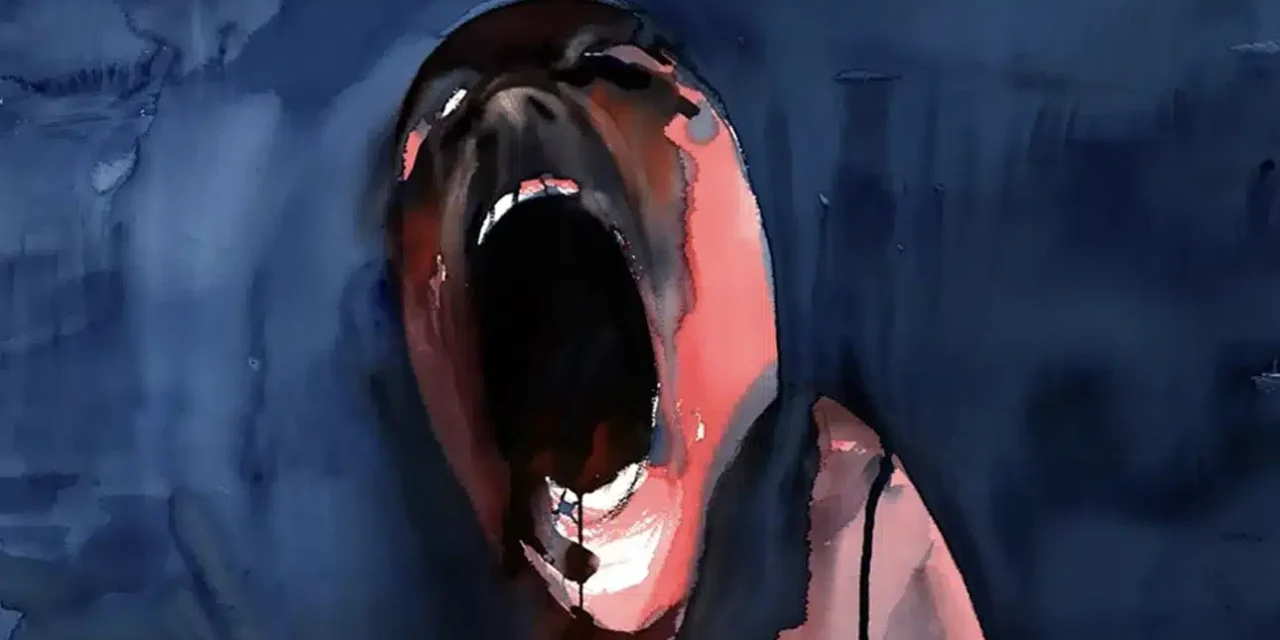
Whether or not you expertise it because the 1979 album, Roger Waters and Gerald Scarfe’s enthralling stage present throughout Pink Floyd’s 1980-81 tour, or Alan Parker’s 1982 movie, The Wall reveals that haunting isn’t merely about wailing specters; it encompasses trauma, alienation, and absence. Spanning 90 minutes, this rock opera embodies a grand narrative informed by means of music and imagery.
On a deeper degree—usually ignored by critics disinterested in rock as an artwork kind for the reason that Nineteen Eighties—The Wall is haunted by three specters paying homage to these in Charles Dickens’ A Christmas Carol. Pink Floyd’s phantoms, nevertheless, are three vital theorists: Sigmund Freud represents the ghost of Christmas Previous; Karl Marx, the ghost of Christmas Current; and Jacques Derrida, the ghost of Christmas Future.
Within the movie, Bob Geldof’s character Pink, very like Dickens’ Scrooge, is plagued by his previous, current, and future, in the end breaking free after a judgment resulting in an unsure future. The album poses the query, “Isn’t this the place we got here in?”, suggesting a return to the place all of it started. Nonetheless, the movie hints at closure by way of a brighter rendition of “Outdoors the Wall,” suggesting that the “bleeding hearts and artists” might discover some decision.
Waters struggled to find out whether or not The Wall represents a cycle or a path to redemption. Maybe it encompasses each. But, akin to all hauntings, the one assure is recurrence.
Sigmund Freud: The Ghost of Christmas Previous
The Wall is completely haunted by previous experiences, each in its thematic depth and its kind, notably drawing from Roger Waters’ personal life. His songwriting advanced into more and more private reflections from The Darkish Facet of the Moon (1973) and Want You Have been Right here (1975) to Animals (1977) and in the end, The Wall (1979). The latter addresses his absent father (who died in motion in 1944), his overbearing mom, tyrannical schoolteachers, and his marital dissolution—every contributing to Pink’s traumatic experiences.
These experiences form particular person songs, their ache specific in “The Trial,” the place absent figures seem as literal ghosts. Every determine imparts a long-lasting influence: a son disadvantaged of a father, suffocated by a mom who “would possibly allow you to sing however received’t allow you to fly,” plagued by abusive academics, and betrayed by an untrue associate. The Oedipal themes are clear, and these primal scenes carve trauma into Pink’s grownup psyche, their specters lingering on to have an effect on his current.
Following a Freudian sample, trauma insists upon repetition. Abuse results in additional abuse. Lecturers who hurt college students are themselves victims of their very own experiences; self-loathing manifests as violence, as seen when Pink tells his spouse, “I would like you / To beat to a pulp on a Saturday night time.” His harmful conduct in lodge rooms has turn out to be a part of rock ‘n’ roll lore, however in “One among My Turns,” it’s distressing—a ritual of self-hatred.
Pink’s relationships crumble, and he seeks validation by means of fame. He finds no belief in girls and views house as an unkempt lodge room. “The present should go on,” however it belongs to another person.
Freud posits in Past the Pleasure Precept (1920) that we frequently search to repeat our most painful experiences, trying to attain mastery over them. For a musician, repetition turns into an important side of their apply, reworking uncooked feelings into polished approach.
This technique of repetition results in a mastery that in the end leads to alienation. The hauntingly lovely however emotionally indifferent guitar solo closing “Is There Anyone Out There?” exemplifies this concept, culminating in Pink’s entrapment behind his personal wall.
Karl Marx: The Ghost of Christmas Current
Even these unfamiliar with Derrida can observe the specters Marx casts in as we speak’s world, with alienation, commodification, and spectacle epitomizing trendy existence. These concepts permeate The Wall.
Waters grew up in a socialist family, with mother and father actively concerned in Trotskyism, shaping his worldview. Regardless of a need for materials success—like shopping for a Bentley—he mocked bandmate Rick Wright for buying a rustic mansion, highlighting his inner battle.
Waters struggles to synthesize his conflicting beliefs. Whereas The Darkish Facet of the Moon supplied empathy to these scarred by capitalism, his musical tone turned more and more vitriolic in subsequent albums. In Animals, class disdain is expressed by means of allegorical animals; by The Wall, that rage turns inward, revealing the commercialization of id.
Pink, each product and creator, turns into worthwhile but estranged from his personal artistry. His life transforms right into a staged efficiency of relentless repetition, enforced by trade forces, leaving him distanced from any that means he as soon as supposed. The present continues, however it isn’t his; he’s consumed, and his alienation is offered again to the viewers.
This dynamic is manifestly evident throughout the fascist rally scene within the movie, which critiques mass spectacle and authoritarianism alike. The viewers eagerly consumes Pink’s picture quite than his presence, demonstrating the unsettling nature of alienation. Every cheer celebrates labor that’s divorced from self-awareness; they cheer for their very own subjugation.
Jacques Derrida: The Ghost of Christmas Future
If Freud burdens The Wall with its previous traumas and Marx hyperlinks it to the alienation of the current, then Derrida’s ghost highlights the fractured nature of id, language, and time.
Derrida notes in Specters of Marx (1993) that the long run is unattainable and perpetually to come back, by no means absolutely inside attain. Pink’s future stays shrouded in uncertainty; we by no means really uncover what lies past the wall.
Like its predecessor, The Darkish Facet of the Moon, The Wall crafts a poetic lexicon steeped in dualities. Whereas the previous hints at themes of sunshine/darkish and sane/insane, The Wall narrows its focus to inside/outdoors, revealing Pink’s interiority as a jail and the skin as an abyss. The seek for freedom turns into a seek for id.
Pink’s essence is perpetually doubtful; he’s not absolutely current, merely a “surrogate band.” As Derrida asserts in Of Grammatology (1967), presence is a transient phantasm, at all times deferred as a part of a continuing internet of meanings. Pink’s isolation echoes all through, particularly when he says, “Pink isn’t effectively; he’s again on the lodge,” distancing himself from his personal id.
By means of The Wall, which displays Pink’s relentless quest for a father determine, a spouse, and a way of self, it in the end reveals profound absence. Younger Pink sees his father’s picture solely by way of reflection, a haunting illustration of how fame can’t substitute one’s true self. The movie satirizes the hole glamour of fame, depicting aftershow events full of superficiality and providing little solace.
Furthermore, Pink’s spouse’s betrayal provides to his sense of loss; their joyous marriage ceremony turns into washed away within the rain, their as soon as vibrant union diminished to isolation. In every single place he appears to be like, solely ghosts stay.
The Wall’s Protecting Isolation
Whereas Waters acknowledges that his rock opera displays his personal experiences, the specter of Syd Barrett casts a fair bigger shadow over The Wall. Although Barrett was alive on the time, his absence is felt extra profoundly than his presence; he exists in a paradox of silence. His breakdown resonates all through Waters’ work, starting with “Shine On You Loopy Diamond.”
The wall itself embodies Derrida’s idea of différance, suggesting that that means is each generated and deferred. It guarantees safety whereas in the end confining Pink. Every brick symbolizes the invisible hole between presence and absence. When Pink lastly tears down the wall, a lingering query stays: was something ever behind it, or was the wall his sole actuality all alongside?