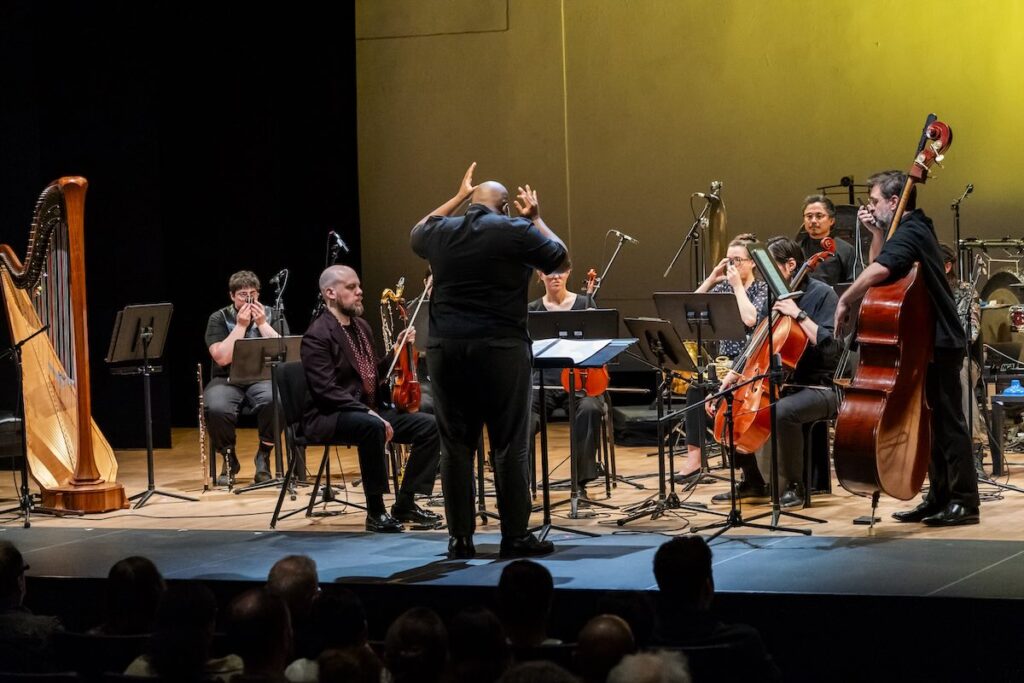
Hannah Kendall captivates audiences together with her intricate tapestry of sound, artfully weaving collectively the narrative of plantation historical past and the glimmers of hope that emerged from its shadows. In essence, her music serves as a transformative time machine. The Worldwide Modern Ensemble, underneath the baton of Vimbayi Kaziboni, showcased her compositions throughout Miller Theatre’s ultimate Composer Portrait of the 2025/2026 season, guiding listeners deep into the emotional and bodily landscapes she evokes. By way of her alternative of distinctive sounds — comparable to kettles and harmonicas — Kendall directs our thoughts and physique into emotions of hysteria and unease, solely to disclose poignant moments of tranquility that resonate deeply.
Carried out with passionate depth by Nuiko Wadden, Tuxedo: Diving Bell 2 (2021) plunges listeners into Kendall’s bewildering sonic realms. The harp, adorned with varied afro hair equipment, surprisingly mimicked tones from devices like bamboo wind chimes and the mbira, making a novel sound palette. This piece is a part of a ten-work collection responding to Jean-Michel Basquiat’s silkscreen art work entitled Tuxedo, which options the phrase “Diving Bell 2.”
Kendall attracts parallels between the Diving Bell and the Center Passage, highlighting the fixed peril current in each contexts, together with the looming risk of dying by drowning. The composition begins with Wadden’s buzzing, alongside vigorous strumming within the harp’s increased registers. The piece regularly provides complexity and depth, plunging towards the darker, extra sinister tones of the harp’s decrease pitches. A standout second options blue and pink plastic hair picks skittering throughout the strings, resembling a ritualistic incantation.
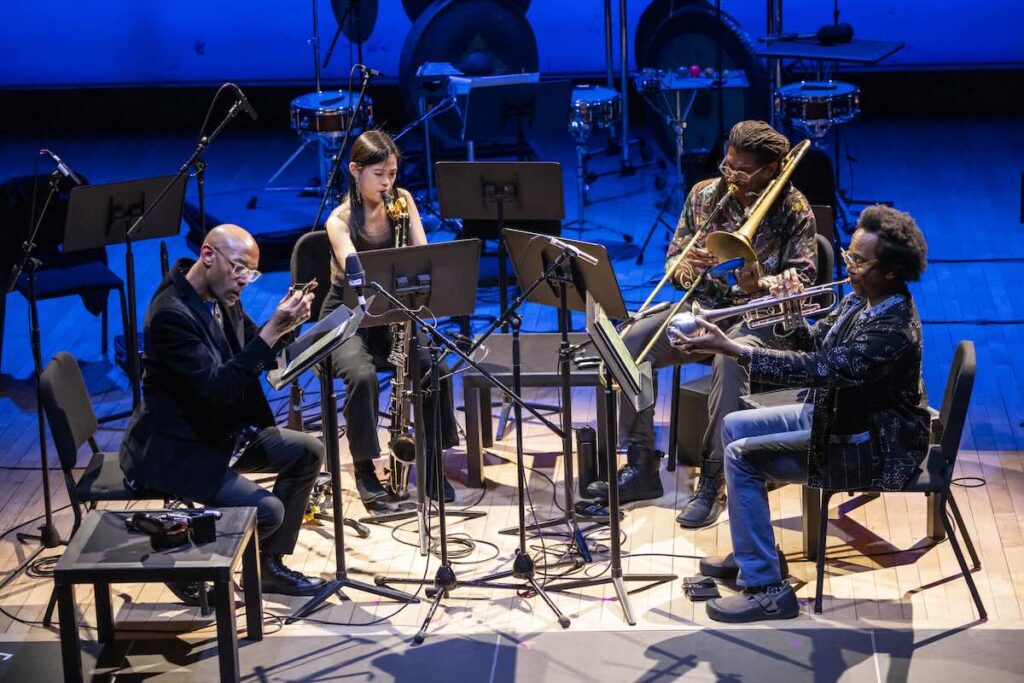
A comfortable shimmer of harmonics opens when flesh is pressed towards the darkish (2024), increasing into Damian Norfleet’s ethereal but calming falsetto, weaving seamlessly with Jonathan Finlayson’s trumpet and Timothy James Robinson’s trombone earlier than cascading into pleasant music field tinklings. This piece additionally displays on the Center Passage, the harrowing journey endured by hundreds of thousands of enslaved Africans. On this work, Kendall introduces one other emblematic aspect of her soundscape: the walkie-talkie. Its static delivers a shimmering texture, capturing numerous tones touring by means of the air. What higher solution to convey a message than by means of the vibrations of sound throughout the waves?
As concord makes an attempt to settle, it’s abruptly disrupted by the growling and overblowing of Emmalie Tello’s bass clarinet. Each sound holds vital symbolism: Norfleet sings whereas overlaying his mouth, struggling to voice his ideas. A bosun’s whistle fluctuates between its pure name and resembling chicken calls, whereas a dolphin emerges within the trumpet melody. Amidst the relentless sonic turbulence, Norfleet softly hums “how nice thou artwork,” accompanied by a toy music field cradled in his arms.
Even sweetness can scratch the throat (2023) evokes photos of sugarcane plantations. Layers of harmonics within the winds and scraping strings symbolize a state of flux. Musicians talk by means of walkie-talkies, their phrases initially indistinguishable earlier than reverberating by means of loudspeakers. Harmonicas performed with prolonged methods create a way of progress, as sounds blossom throughout the stage, mixing with air sounds within the flute that gracefully fade into the harmonic double stops of the viola.
In discussing the U.S. premiere of constructing a burning home (2026) throughout an intermission chat with program director Melissa Smey, Kendall remarked, “I should have a refrain of kettles… they sing and wail concurrently.” This piece plunges us into the disquieting ambiance of a plantation kitchen at daybreak. Levy Lorenzo’s snare drum resonates as marbles clattering throughout an uneven flooring, instilling a way of unease. A haunting array of bells chimes above, scary ideas concerning the stark contrasts between ornamental bracelets on the wind gamers’ wrists and the shackles that when certain people, conjuring collective reminiscences.
Amidst the fervent, corporeal expressions of sound produced by violinist Modney and violist Carrie Frey, the spirited piccolo of Isabel Lepanto Gleicher and Tello’s full of life clarinet conjure the imagery of a kettle boiling. Kendall’s anticipated refrain begins because the musicians decide up kettles from the ground and produce them to their mouths, inviting poignant reflections on the phrases spoken into these vessels and the ensuing echoes of screams.
This live performance was not meant to be soothing or entertaining; fairly, it conveyed its narratives on a number of ranges. The bodily essence of the music, ranging from the stage, resonates throughout the viewers, eliciting motion and emotional responses. By way of discomfort, Kendall compels us to have interaction with the profound ideas these works evoke, compelling us to visualise the complicated photos her music evokes.
I CARE IF YOU LISTEN is an editorially-independent program of the American Composers Discussion board, and is made potential because of beneficiant donor and institutional help. You’ll be able to help the work of ICIYL with a tax-deductible present to ACF. For extra on ACF, go to composersforum.org.