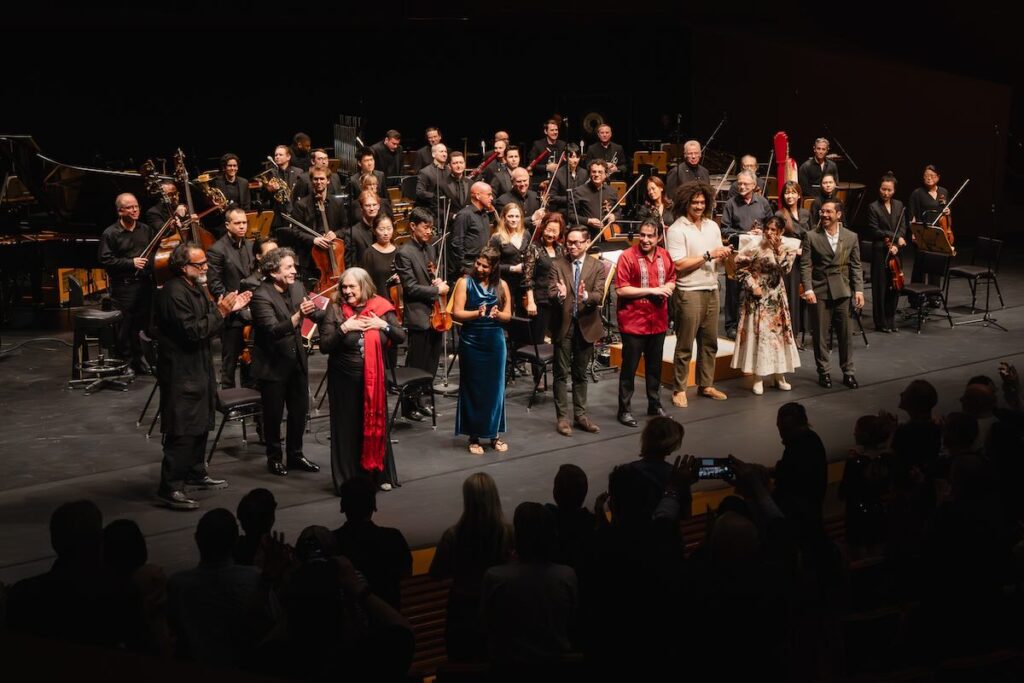
Preserving historical past is crucial for sustaining our cultural reminiscence, permitting us to reintroduce and reinforce important narratives for each new and returning audiences. On March 7, the Los Angeles Philharmonic took a significant step on this route. Below the route of Gustavo Dudamel and curated by Gabriela Ortiz, The Nice Wall of Los Angeles showcased six commissioned works impressed by Judy Baca’s iconic mural, reflecting the advanced historical past of town by numerous inventive mediums. Accompanying this mix of efficiency was a movie by Academy Award-winning filmmaker Alejandro G. Iñárritu, projected above the orchestra. Over 50 years after its inception, Baca’s mural continues to encourage a brand new era of artists to rekindle tales from the previous, lots of which resonate powerfully in at the moment’s world.
As an illustration, whereas attendees at Walt Disney Live performance Corridor that Saturday afternoon had been seemingly conscious of the current aggressive Immigration and Customs Enforcement (ICE) raids within the Los Angeles group, what number of knew concerning the 500,000 Mexican People deported in the course of the Nice Melancholy? This reflection highlights a troubling continuity: practically a century later, related rhetoric justifies inhumane practices concerning immigration.
In Estevan Olmos’ piece, Sin Terra Sin Voz, the movie captures poignant photos of Mexican People in chains, juxtaposed with scenes of working-class people hanging for honest wages. The music begins with an upbeat jazz rhythm, which evolves right into a energetic snare-driven piece, illuminated by vibrant lighting over photos of the Dunbar Resort—a historic landmark for Black Angelenos throughout the Central Avenue jazz scene. A soothing English horn solo floats above the orchestra, epitomizing resilience as a mom and baby traverse the mural’s depiction of the Mud Bowl migrations from the Nineteen Thirties, lending the composition its quiet power.

In ¡AGUAS!, Nicolás Lell Benavides displays on the Zoot Go well with Riots, occasions that considerably impacted younger Latinos, notably Mexican People. Mambo, favored by lots of the focused males, serves because the inspiration for this energetic composition. The preliminary drum solo provides option to a various array of percussion devices—whistles, ratchets, and cowbells—whereas the concertmaster leads a dynamic call-and-response with the string part.
In Xavier Muzik’s God, the Model, the movie first obscures the mural, setting the stage for an exploration of previous and current. The piece intertwines quick musical passages with lyrical melodies, punctuated by sudden bursts of low brass. Solos from numerous sections of the orchestra emerge, beginning with a viola, adopted by the concertmaster, and a largely pizzicato passage from the double bass. Movies weave archival footage of Baca strolling beside the unique clean wall with current scenes of her in entrance of the absolutely realized mural.
In Viet Cuong’s Ladders, Baca is once more depicted navigating the mural’s darkness with a torch. This composition attracts from LGBTQ+ historical past represented within the mural, particularly the Daughters of Bilitis, America’s first lesbian civil rights group, and their publication, The Ladder. A energetic jig emerges from the strings and piano, later joined by percussion, in opposition to a backdrop of photos showcasing athletes and entertainers. The intense musical contrasts with the somber mural imagery, reflecting a time when queer people might solely discover protected areas within the shadows. Because the wind part highlights speedy passages, the piece stays vibrant and pulsating with life, ultimately fading into a mild conclusion.
Nina Shekhar’s Westbound addresses the theme of westward growth, which was largely enabled by Chinese language immigrants who constructed the railroads. This percussive work mimics the strenuous circumstances of labor, with the orchestra stomping in unison, strings using snap pizzicato, and steel percussion echoing instruments clinking. A haunting low brass fanfare darkens the tone whereas the visuals reveal stark contrasts between the lives of those that constructed the trains and those that rode them.
All through the live performance, the idea of motion—each literal and symbolic—was explored extensively. Nonetheless, Juhi Bansal’s A Lone Voice within the Darkness tells a special story. This composition highlights California’s Indigenous historical past, specializing in the “lone lady,” a member of the Nicoleño tribe who survived in isolation for 18 years following her tribe’s displacement. The opening incorporates a trio of cellos creating gentle, lyrical harmonies paired with winds that produce a fierce, pitchless wind-like sound. The haunting melody struggles in opposition to the chaos as the complete orchestra swells in, solely to reemerge earlier than gently fading away.
The Nice Wall of Los Angeles embodies the sentiment that what was as soon as outdated will be rejuvenated. Conflicts can echo by time, and up to date challenges usually trace at historic patterns. That is additionally true for artwork. The commissioned composers and Iñárritu haven’t solely honored Baca’s legacy by celebrating Los Angeles’ wealthy historical past; they’ve additionally facilitated alternatives for brand new audiences to have interaction with this foundational art work. Right here, artwork serves to doc historical past whereas concurrently changing into part of it—a testomony to the important interconnections amongst artists that preserve our tales alive.
I CARE IF YOU LISTEN is an editorially-independent program of the American Composers Discussion board, made potential by beneficiant donor and institutional assist. You may assist the work of ICIYL with a tax-deductible reward to ACF. For extra on ACF, go to composersforum.org.